

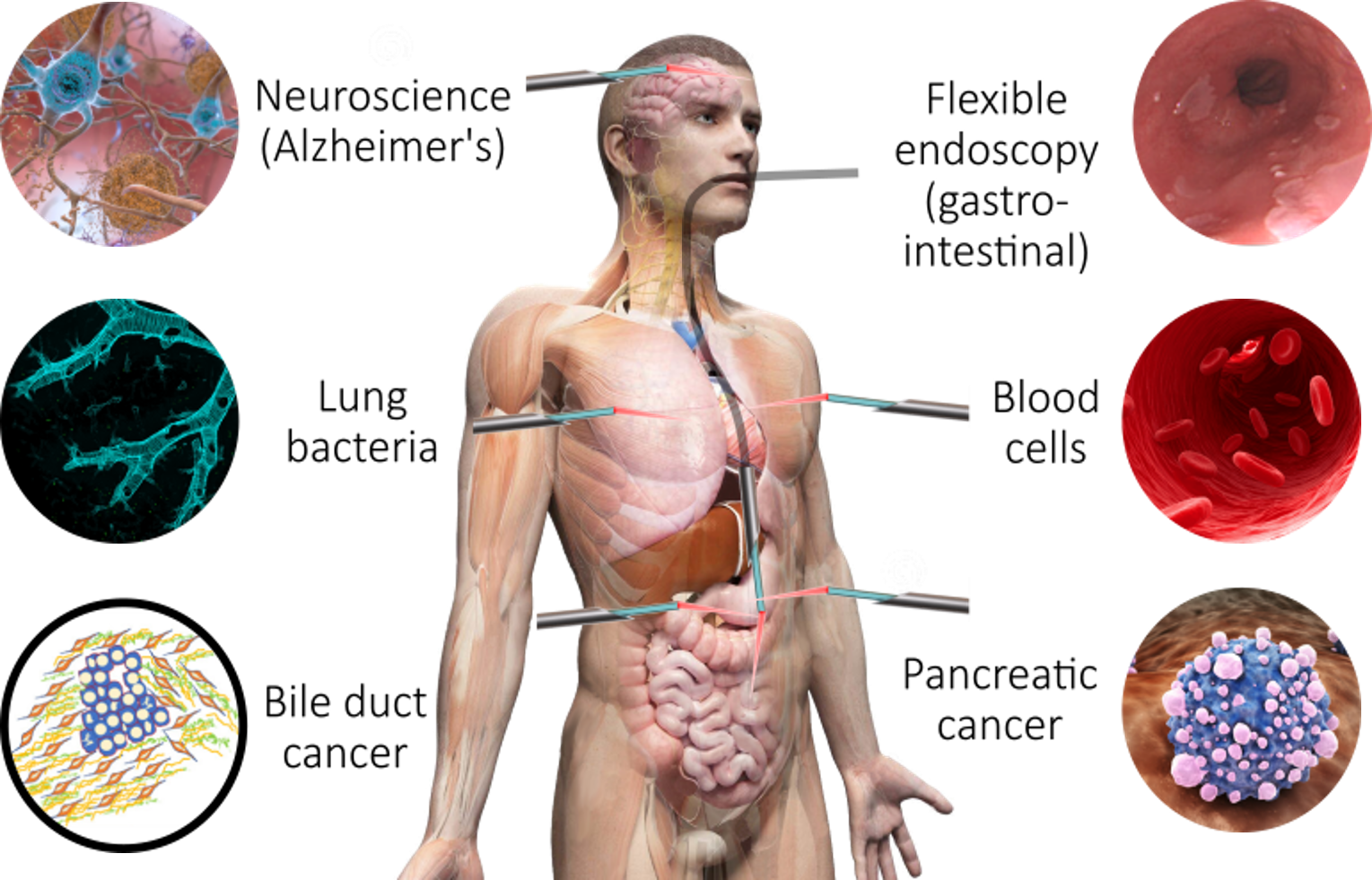
Optical technologies for imaging where conventional tools cannot reach. (Left to right) An optical fibre with a metasurface reflector stack; images of oesophageal tissue reconstructed through a 2 m-long, 500 μm-diameter fibre, using quantitative phase information to enhance contrast between healthy and tumour tissue; and potential applications of optical imaging across the body, illustrated with probes and examples of biological structures.
I am an Assistant Professor and UKRI Future Leaders Fellow in the Department of Chemical Engineering and Biotechnology at the University of Cambridge. I lead the Optics for Intelligent Measurement (OPTIM) lab, where we develop optical sensing and imaging technologies for healthcare, biotechnology and other challenging environments.
Our aim is to sense and image where conventional technologies cannot. Our research connects three themes: photonic sensors and materials, computational sensing and AI, and healthcare translation. We work across the full measurement process, from sensor design and fabrication through calibration, reconstruction and interpretation to experimental and clinical evaluation.
We develop hair-thin optical fibre imaging probes, meta-optics and miniaturised devices that control how light interacts with a sample. This includes planar lenses on fibre tips and spectral filters tailored to particular imaging tasks. Combining these devices with computational methods enables compact instruments that recover more information from the light they collect.
Computational sensing and AI are central to this work. We develop methods for calibrating optical fibres, reconstructing images from complex measurements and extracting physically interpretable information from biomedical data. Physical models and experimental validation help us understand how these methods work and where they can be used reliably.
Working with clinical collaborators, we develop and evaluate technologies for minimally invasive imaging and earlier disease detection. Our work spans miniaturised quantitative endoscopy, label-free tissue contrast and studies of the practical requirements and safety of endoscopic procedures.
Explore the Research page to learn more about our themes and projects.
Before joining Cambridge, I was an Assistant Professor and subsequently Associate Professor at the University of Nottingham, where I established and grew my current research programme. Prior to that, I was a postdoctoral researcher at the University of Cambridge, where I developed a fully holographic fibre endoscope and low-cost quantitative imaging techniques for improved early cancer detection.
I received my PhD from the University of Cambridge in 2013 for research in wireless and optical telecommunications. I am the author of more than 30 peer-reviewed journal publications spanning optical fibres, biomedical imaging, nanophotonics, sensor technologies and machine learning.
My technical expertise includes programming in a variety of languages (including MATLAB, Python and C++), using AI-assisted development tools such as Codex; machine learning and statistical data analysis using frameworks including PyTorch, TensorFlow and Stan, together with Bayesian techniques; and the design and construction of optical systems, metamaterials and microsystems, optical experiments, and optical simulation and modelling.
Recent publicity:
George joins the Department of Chemical and Engineering Biotechnology at the University of Cambridge.
George selected as one of ElectroOptics Magazine Photonics100 awardees
Major multidisciplinary grant awarded for combining snake-robot with ultrathin imaging for treating bile duct cancer
System for early diagnosis of gastrointestinal cancers
Video interview for study on aerosol generation during endoscopy
Cancer Research UK Early Detection of Pancreatic Cancer Innovation Sandpit: Team ReTHOMS
UKRI Press Release about my Future Leaders Fellowship
University of Nottingham Press Release about my UKRI Future Leaders Fellowship
Article in the i about my fellowship
Interview with AZoOptics about my fibre imaging work